In the remote hills of Northeast India, jewellery has long been far more than decoration. Among the many Naga communities traditionally associated with the region known today as Nagaland and neighbouring areas, necklaces formed part of a rich visual language through which identity, belonging and social life could be expressed.
Bold, tactile and immediately recognisable, traditional Naga necklaces bring together colour, texture and materials in combinations that feel surprisingly contemporary. Yet behind their striking appearance lies a much deeper story.
Jewellery as a Language
Historically, adornment among Naga communities could communicate information about the wearer and their place within society. Clothing, ornaments and ceremonial objects were connected to community identity, age, gender, achievements and social standing, although customs varied considerably between different Naga groups.
For this reason, it is misleading to think of a “Nagaland necklace” as belonging to a single, uniform tradition. Nagaland is home to numerous Naga communities, each with its own history and distinctive forms of dress and ornamentation.
A necklace could therefore be beautiful while also carrying meanings understood within the community in which it was made and worn.
A Fascinating Vocabulary of Materials
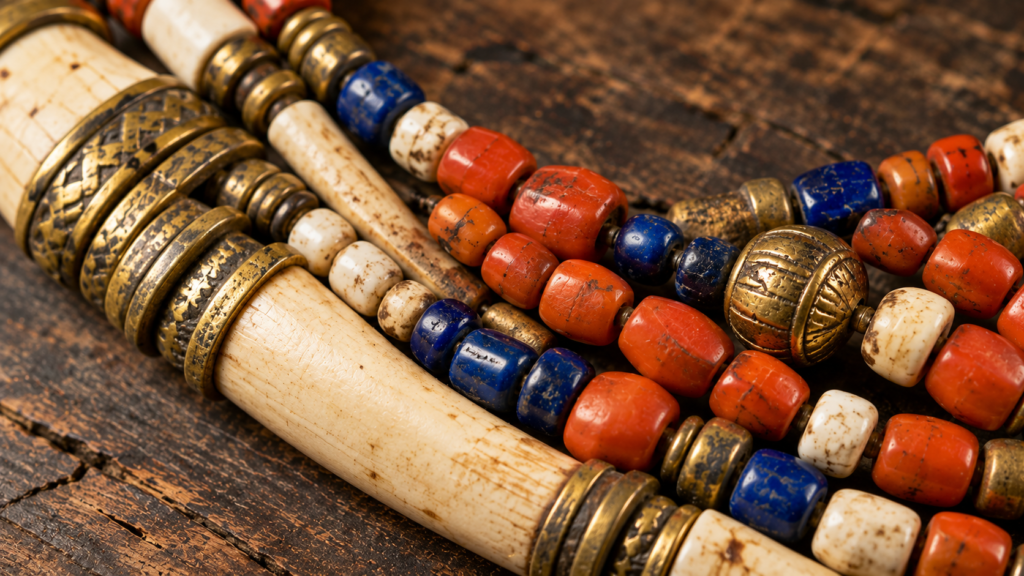
One of the most captivating characteristics of Naga jewellery is its use of materials.
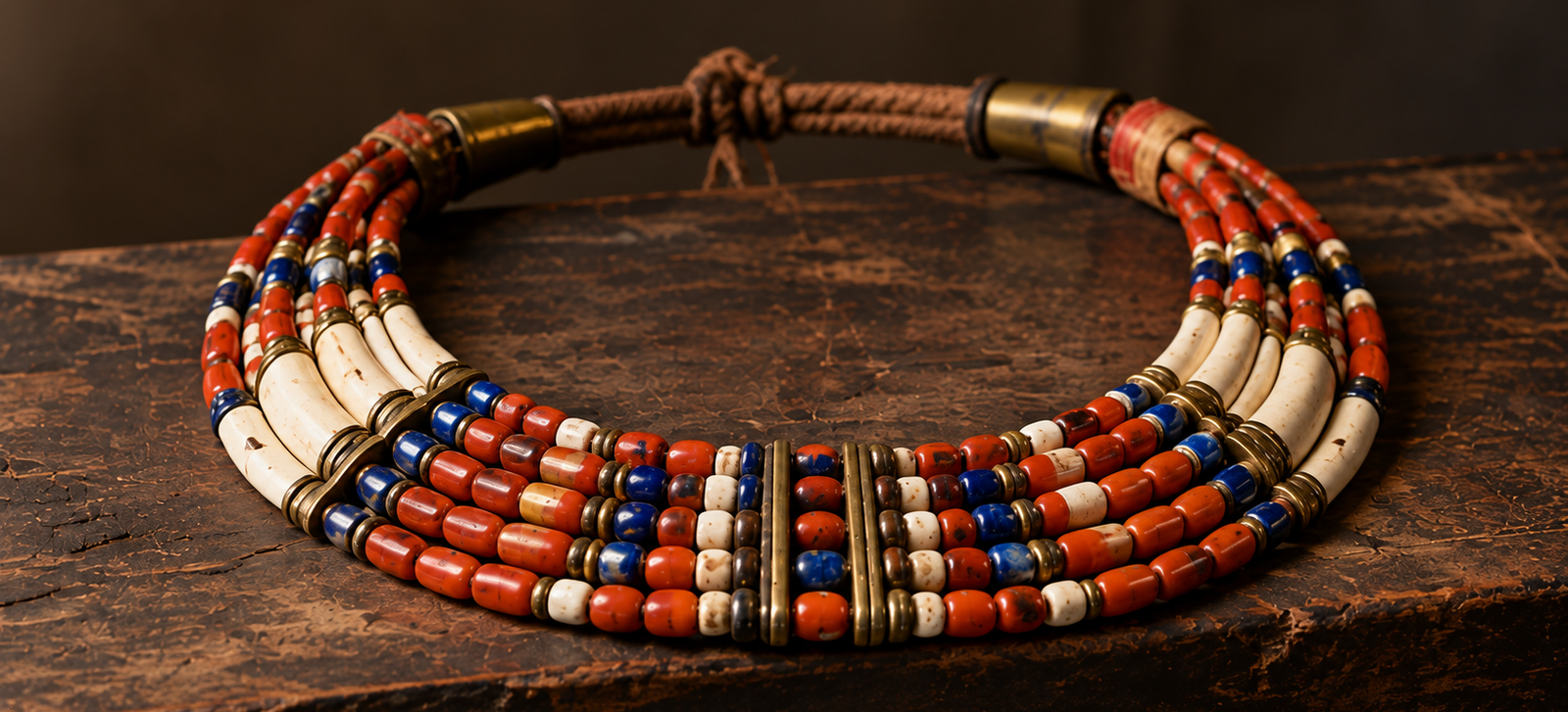
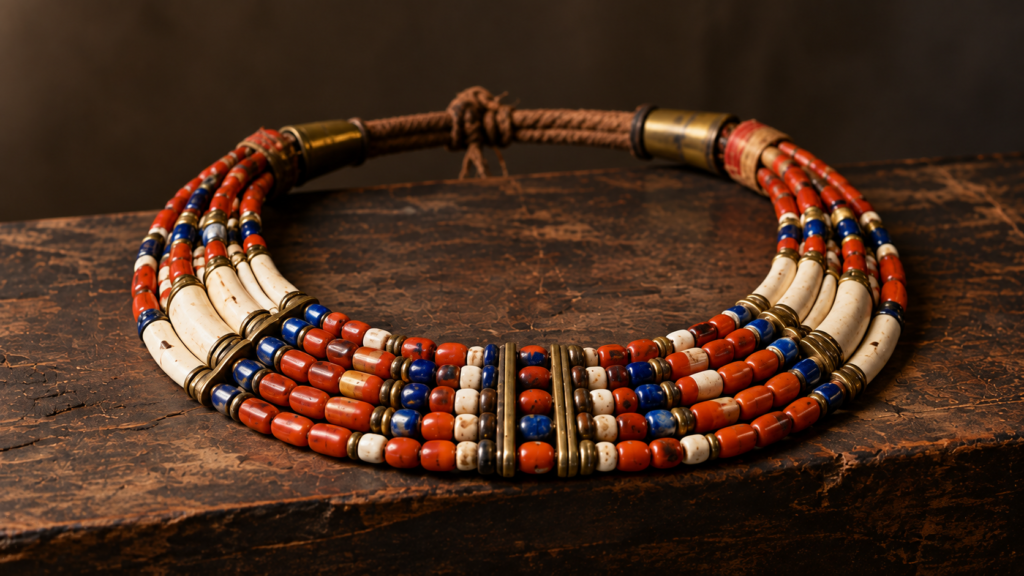
Traditional necklaces may incorporate glass beads, shells, bone, brass, metal elements, seeds and other locally available or traded materials. Older examples can reveal fascinating networks of exchange: beads and other components travelled considerable distances before becoming part of ornaments made in the hills.
Red, orange, black, white and deep blue frequently create dramatic contrasts. Multiple strands add volume, while pendants and larger central elements give certain pieces an almost sculptural quality.
There is an appealing freedom in these combinations. Preciousness is not necessarily defined by gold or gemstones. Instead, value can emerge from rarity, craftsmanship, symbolism, history and the significance attributed to particular materials.
Made to Be Seen
Naga necklaces rarely disappear quietly into an outfit.
Their proportions, repetition and strong colours give them a remarkable presence. Rows of beads may fall closely around the neck or form substantial layers across the chest. Some pieces combine small, meticulously arranged components with large pendants or symbolic forms.
Seen outside their original context, their geometry can appear unexpectedly modern. This is perhaps one reason why Naga jewellery continues to fascinate collectors, designers and travellers.
But viewing these pieces simply as “tribal style” risks overlooking what makes them truly interesting. Their aesthetic power grew from particular cultures, communities and traditions rather than from a decorative trend.
Objects That Travel
There is another story hidden inside many old necklaces: the story of movement.
Materials travelled. Techniques were passed between generations. Objects changed hands. A necklace might have begun its life as something deeply personal or ceremonial and, decades later, find itself in a collection thousands of kilometres from the place where it was created.
This journey makes provenance especially important.
Age, materials and origin should not be assumed simply from appearance. Contemporary necklaces inspired by traditional Naga jewellery exist alongside vintage and older pieces, and similar components may appear in jewellery from different communities and regions.
For collectors, learning where a piece came from can be as compelling as the object itself.
Collecting with Curiosity and Respect
To collect traditional jewellery is to become, temporarily or permanently, the custodian of someone else’s material culture.
That does not mean these objects should remain hidden away. Quite the opposite. They can be worn, displayed and appreciated. But they deserve to be described carefully, avoiding invented symbolism or romantic stories that cannot be supported by what is actually known about a piece.
Sometimes the most truthful description is simply that the exact community, date or original meaning is unknown.
There is beauty in that uncertainty too.
It reminds us that an old object does not have to reveal every chapter of its history to retain its power.
The Beauty of Things with a Past
Perhaps this is what makes Naga necklaces so compelling today.
They are visually powerful objects, but their appeal extends beyond colour and form. They speak of craftsmanship, exchange, identity and the human desire to transform materials into something meaningful.
Placed in a contemporary interior, an old necklace can become almost sculptural. Worn with simple clothing, it can completely change a silhouette. Collected as an object, it invites questions about where it was made, who wore it and how it travelled.
At Silk Route Spire, these are the objects that interest us most: pieces that carry evidence of another place and another pair of hands.
Not simply things to own, but things that encourage us to look closer.
Collected along the way. Chosen for the stories they carry.